God does not beget
The necessary being is beginningless, so it does not have parents. If it has no parents, then it has no siblings. Moreover, the necessary being is immaterial, and this renders mating and sexual reproduction impossible. As for asexual reproduction, which is when a single parent produces typically identical offspring, this is incompatible with the characteristics of the necessary being. Asexual reproduction, as observed in organisms like bacteria (through binary fission) or hydra (through budding), involves a type of separation of parts to produce offspring. However, an immaterial being is not made up of parts that can separate. As such, reproduction, whether sexual or asexual, is not applicable to the necessary being.

One might argue that a necessary being could, in some way, produce offspring without separating into parts. However, this raises the question of what exactly is meant by ‘offspring’? It might be suggested that the necessary being creates identical copies of itself, yet it would be more accurate to describe such copies as creations rather than true offspring. Furthermore, these created beings would not be truly identical, as they are contingent, whereas the necessary being exists by necessity. Additionally, contingent beings cannot share any attribute with the necessary being, as doing so would undermine the very concept of necessity, as discussed in the article concerning the third proof of monotheism.
Another suggestion is that the necessary being could have children through a concept known as emanationism, where its emanations are understood as originating from the necessary being and can be viewed as offspring. This idea is reflected in mainstream Christian theology in the Doctrine of Divine Procession. According to Christianity, God exists in a Trinity as three distinct persons: the Father, the Son, and the Holy Spirit. Each of these persons is said to be fully God, yet Christianity teaches that there is only one God and not three gods. Christians say these persons are coequal, co-eternal, and consubstantial, as they share the same divine essence. In mainstream Christianity, which includes Roman Catholicism, Eastern Orthodoxy, and most of Protestantism, each person is considered necessary in existence, but there is a distinction regarding their origin; the Father is said to possess aseity, meaning he exists independently and is not derived from anything else, while the Son and the Holy Spirit do not have aseity in terms of origin but instead proceed from the Father.
Thus, the Son and Holy Spirit could be considered to be emanations of the Father, even though many Christians would not use this type of language. Instead, they would describe the Son to be begotten of the Father, while the Holy Spirit is said to proceed from the Father. Only the Son is considered to be the literal and begotten child of the Father, while the Holy Spirit is not considered as such. According to the Roman Catholic Church and most Protestants, the Holy Spirit also proceeds from the Son, while the position of the Eastern Orthodox Church is that the Holy Spirit proceeds from the Father alone. This theological disagreement, known as the Filioque controversy, was one of the key issues that led to the split between the Western (Roman Catholic) and Eastern (Orthodox) branches of Christianity.
Despite all of this, the necessary being cannot have children in the sense of generating emanations because these emanations would also be necessary in existence. As mentioned in the article concerning monotheism and emanationism, there can only be one necessary being. Christians may respond that they only believe in one necessary being. However, they believe God is one being who exists as three different persons. Three different persons are three different beings, and so this would result in three gods and three necessary beings.



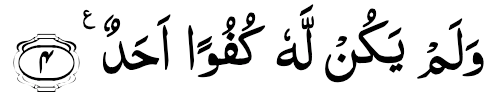
Perhaps the final way a person could claim that the necessary being has children is in the sense of metaphor. The necessary being created all things. It sustains and nurtures creation. In this sense, one could say that the necessary being is a type of guardian, while its creation are children. This does not seem to bring about any logical problems.
However, In Islām, Allāh is not said to have children metaphorically in order to prevent confusion. Islām teaches that there were many prophets. Perhaps it was allowed to say that Allāh has children metaphorically in the times of the earlier prophets, but Allāh knows best. Furthermore, the Qurʾān threatens and warns those who say that Allāh has children (Qurʾān 18:4-5). Thus, Muslims are cautious to say that Allāh has children even in the sense of metaphor due to the fear of divine punishment.
 Dawah Vision
Leave a comment