The most common types of arguments for God's existence
- Cosmological argument
- Argument from revelation
- Teleological (design) argument
- Argument from consciousness
- Argument from fiṭrah (innate predisposition)
- Transcendental argument
- Ontological argument
- Moral argument
There are numerous arguments for God’s existence. The list above includes some of the most commonly utilized types of arguments for God’s existence, which should not be conflated with particular arguments for God’s existence. Later articles will generally center on cosmological arguments, while the argument from revelation will be used in a later book to argue for God’s existence, as well as the prophethood of Muḥammad ﷺ.
Cosmological argument
A cosmological argument is a type of argument that argues for the existence of a necessary being, generally identified as Allāh (God), based on inferences drawn from observations of the universe. There are many particular arguments that are classified as cosmological arguments. The first stage or objective of cosmological arguments is to establish the existence of a necessary being. A necessary being is an uncreated being whose existence is necessary, meaning it must exist and cannot fail to exist, and so it must always be included within reality because it has no beginning or end. The second stage or objective of cosmological arguments is to identify this necessary being as Allāh (God).
Unity and disunity between theists and atheists
Both theists and atheists can agree on the existence of a necessary being, although many atheists reject that such a being exists. The main point of contention, however, often lies in the second stage or objective of cosmological arguments, which is to identify this being as God. Theists accept the existence of at least one deity. Atheists either deny the existence of any deity or simply lack belief in any deity [1]. If atheists deny God yet acknowledge the existence of a necessary being, then they are, in a sense, not too far removed from tawḥīd (Islāmic monotheism).
Argument from revelation
The argument from revelation argues that God exists because he has revealed waḥy (revelation) that contains such miraculous information that could not have possibly been from any source besides an omnipotent and omniscient being. In this context, the argument from revelation is a type of argument from miracles. People who have received waḥy are known as prophets (anbiyāʾ). Waḥy is essentially a message from God. Religions typically claim that waḥy has been recorded in text, although it may also be passed on through a type of oral tradition. Nevertheless, there are criteria to determine if a particular message is indeed waḥy from God, as mentioned in the previous article; true waḥy from God must have a correct concept of God, must be preserved, and must be inerrant. However, these conditions are not enough to prove if a particular message is indeed waḥy or not because anyone can formulate a message fulfilling these conditions. If a particular message seeks to convince others that it is indeed waḥy, then it should contain miraculous information indicating that it is from the divine.
What if those who reported the occurrence of miracles lied or underwent mass hysteria?
Muslims claim that Prophet Muḥammad ﷺ performed miraculous feats that were witnessed by many people. The Qurʾān and the aḥādīth mention these miracles, and numerous people reported these miracles to others. Reports of many of these miracles reach the level of mutawātir, which means these reports were mass-transmitted by so many people that it is practically impossible for all of them to have agreed to lie. To claim that the miracle did not occur is to claim a massive conspiracy or a mass hysteria event took place. However, even if one denies all of these reports and claims that the Muslims lied and invented them in order to propagate Islām or that all of the reporters underwent mass hysteria, there is another type of miracle that can be observed today which substantiates Islām: the miracle of prophecy.
To explain, imagine a person walks on water without the use of any technology or sorcery. Numerous people then report this event in the past. The miracle may have occurred, or the reporters lied or underwent mass hysteria. However, if this person prophesies that all people over six feet tall will become bald in the future, and this prophecy is recorded, and then this prediction actualizes, then this is a strong indicator of prophethood because it is a highly specific and unlikely occurrence. Furthermore, if people of today can observe the fulfillment of the prophecy, then it cannot be claimed that there is mass hysteria or a massive conspiracy taking place. Perhaps one can say that the prophecy’s fulfillment is just luck or a coincidence, but if such predictions keep actualizing repeatedly, then this establishes prophethood.
Prophet Muḥammad ﷺ made multiple highly specific and unlikely prophecies, yet they came true. The fulfillment of many of these prophecies can be seen today. Besides Islāmic prophecies, the Qurʾān claims that Prophet Muḥammad ﷺ has been mentioned in the Tawrāh (Torah) and the Injīl (Gospel).
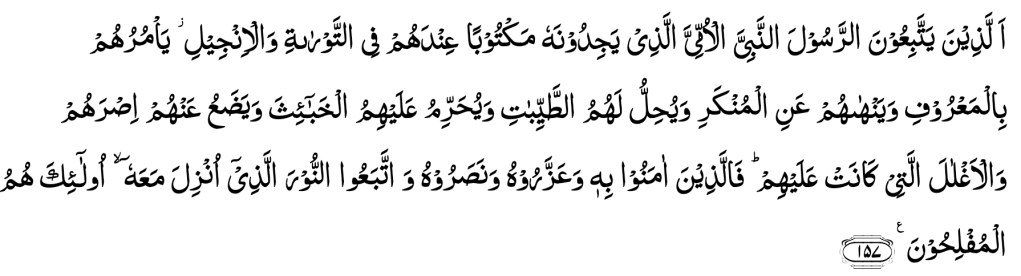
If the Tawrāh and the Injīl truly prophesy the coming of Prophet Muḥammad ﷺ, and these scriptures came many centuries before Muḥammad ﷺ, then this is a strong indication of the truthfulness of the Prophet ﷺ.
Why do Muslims utilize Jewish and Christian texts to argue for the prophethood of Muḥammad ﷺ if they believe these texts are corrupted?
The Qurʾān teaches that the Tawrāh and the Injīl have been corrupted and that the Qurʾān itself serves as a criterion over these scriptures (Qurʾān 5:48). At the same time, the Qurʾān mentions that Prophet Muḥammad ﷺ has been mentioned in these previous religious scriptures. Many criticize Muslims who use Jewish and Christian texts to substantiate the prophethood of Muḥammad ﷺ because they claim that it is inconsistent for Muslims to do this and at the same time claim that these texts are corrupted. The argument of these critics is that one should not use a corrupt text to support one’s beliefs because the specific references that are used may also be corrupted. While this is a possibility, the response is that Jewish and Christian texts are only used as supplementary evidence to confirm the truthfulness of Muḥammad ﷺ. Muslims do not need these texts to argue for Islām whatsoever; the miracles and prophecies of Islām, among many other signs, are enough proof for Islām.
[1] Agnostics are uncertain if any deity exists. Some argue that the term 'atheist' should be reserved for those who deny the existence of any deity, as opposed to those who simply lack belief in any deity. However, under the broader and more widely used definition of atheism, which is the absence of belief in a deity, agnostics are often grouped within this category. Despite this, it is important to recognize the distinction, as agnosticism emphasizes uncertainty rather than a definitive stance on belief.
 Dawah Vision
Leave a comment